
✨ This article was AI edited. Editorial responsibility: TopElectricShavers.net.
Produced with AI. This article was artificially generated. Editorial responsibility: TopElectricShavers.net.
Shaving gel is a concentrated, low-density grooming lubricant formulated with lubricating polymers, humectants (like glycerin and aloe vera), and surfactant emulsifiers designed to create an ultra-slick microscopic barrier between the cutting blade and epidermal skin layers. Unlike traditional aerated shaving foams, clear shaving gels do not obscure facial contours, allowing high-precision beard edging and significantly reduced friction on sensitive skin.
Every time an edge sweeps across human skin—whether from a multi-blade cartridge, a traditional safety razor, or a high-velocity wet/dry electric shaver—it encounters substantial kinetic friction. Dry facial keratin is remarkably tough, boasting a tensile strength comparable to copper wire of equivalent diameter. Without an engineered interfacial lubricating fluid, cutting edges drag against dry hair fibers, causing microscopic epidermal tearing, razor burn, and follicular inflammation.
While vintage grooming routines favored bulky soaps and aerosolized shaving foams, contemporary dermatological science has shifted decisively toward shaving gels. Formulated with advanced high-molecular-weight polymers, shaving gels optimize surface glide, hydrate the hair shaft from within, and provide unparalleled visibility for precision line work around mustaches, goatees, and sideburns.
Contents
- Biochemical Mechanism: How Shaving Gel Protects the Dermal Barrier
- Technical Breakdown: Clear Gel vs. Foaming Gel vs. Traditional Cream
- Can You Use Shaving Gel with Wet/Dry Electric Shavers?
- Ingredient Analysis: What to Look For and What to Avoid
- Step-by-Step Application Protocol for an Irritation-Free Shave
- Frequently Asked Questions
Biochemical Mechanism: How Shaving Gel Protects the Dermal Barrier
The protective action of shaving gel operates across three simultaneous physical and chemical pathways:
- Hydration & Keratin Softening: Hair shafts possess a hydrophobic outer cuticle layer. Shaving gels contain mild surfactants and water-binding humectants (such as glycerin, panthenol, and sodium PCA) that penetrate this cuticle, swelling the keratin cortex and reducing the force required to cut hair by up to 65%.
- Boundary Layer Lubrication: Hydrophilic polymers (e.g., hydroxyethylcellulose, carbomer, and PEG compounds) form an ultra-thin aqueous cushion across the stratum corneum. This barrier lowers the kinetic coefficient of friction between steel and epidermal tissue from ~0.45 down to less than 0.12.
- Thermal Dissipation & Glide Maintenance: High-speed electric shavers generate friction heat when operating at 10,000 to 14,000 CPM. A water-dense shaving gel continuously absorbs and dissipates this thermal energy, preventing thermal friction burn on sensitive neck skin.
Technical Breakdown: Clear Gel vs. Foaming Gel vs. Traditional Cream
Understanding formulation differences enables men to select the ideal lubricant for their specific razor type and dermatological profile:
| Performance Vector | Clear Non-Foaming Gel | Post-Foaming Aerosol Gel | Traditional Shaving Cream |
|---|---|---|---|
| Facial Contour Visibility | 100% Transparent (Ideal for beard lining) | Opaque white foam upon lathering | Opaque dense white lather |
| Friction Reduction (Slickness) | Maximum polymer boundary layer | Moderate to high cushion | High cushion, moderate slickness |
| Electric Shaver Compatibility | Excellent (Rinses clean from foil/cutters) | Good (Requires thorough warm rinsing) | Poor (Dense fats clog micro-foils) |
| Skin Barrier Hydration | High (Water & humectant dense) | Moderate (Propellant can be drying) | High (Lipid & fatty acid rich) |
| Alcohol / Propellant Content | Typically 100% alcohol-free | Contains isopentane/isobutane gases | Alcohol-free (fatty soap base) |
Can You Use Shaving Gel with Wet/Dry Electric Shavers?
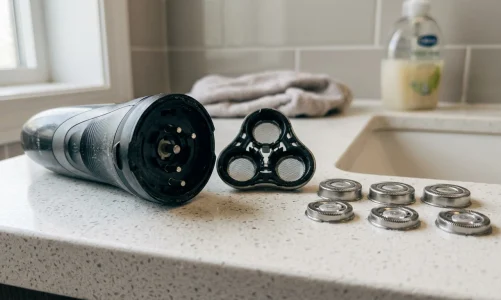
A common misconception is that electric shavers must strictly be used dry. Modern wet/dry foil shavers (such as Braun Series 8/9 and Panasonic Arc5/Arc6) as well as rotary units (Philips Norelco Series 5000/7000/9000) are engineered with 100% waterproof IPX7 chassis explicitly calibrated for wet shaving.
When pairing an electric shaver with shaving lubricant, clear water-soluble shaving gel is unequivocally superior to aerosol foams or dense soap creams. Here is why:
- Foil Slit Ingestion: Electric shaver foils feature micro-apertures measuring only 50 to 80 microns wide. Traditional creams contain saponified tallow, stearic acid, and heavy waxes that create an emulsion paste, blocking hair shafts from entering the foil holes. In contrast, low-viscosity clear gel permits hair to pass effortlessly into the cutting matrix.
- Rapid Hydraulic Flushing: Clear gels dissolve immediately in warm running water. During periodic mid-shave rinses, water clears accumulated stubble from the cutter block in seconds without requiring manual brush disassembly.
- Preservation of Rubber Seals: Aerosol propellants (butane and propane) found in cheap foaming cans can degrade internal synthetic rubber O-rings over time. Tube-dispensed clear gels eliminate propellant contact entirely.
Ingredient Analysis: What to Look For and What to Avoid
To avoid contact dermatitis and prevent follicular clogging, inspect the ingredient deck before purchasing your shaving gel:
Beneficial Dermal Actives:
- Vegetable Glycerin & Hyaluronic Acid: Powerful humectants that draw moisture deep into facial hair, expanding the follicle for effortless cutting.
- Aloe Barbadensis Leaf Juice: Delivers natural polysaccharides and glycoprotein enzymes that soothe micro-abrasions and quell post-shave erythema.
- Bisabolol & Allantoin: Clinically proven anti-irritants derived from chamomile that calm inflamed nerve endings in sensitive skin.
- Panthenol (Pro-Vitamin B5): Strengthens the skin’s lipid moisture barrier and accelerates cellular re-epithelialization after mechanical exfoliation.
Harmful Additives to Avoid (Especially for Sensitive Skin):
- Denatured Alcohol (Alcohol Denat / SD Alcohol 40): Strips natural sebaceous lipids, causing immediate moisture evaporation, stinging, and reactive sebum overproduction.
- Artificial Fragrances & Dyes (Parfum, Blue 1, Yellow 5): The leading causes of contact dermatitis and allergic flare-ups in men prone to razor bumps.
- Triethanolamine (TEA): A strong emulsifying amine that can trigger skin sensitization and irritation when left in prolonged contact with newly shaved pores.
Step-by-Step Application Protocol for an Irritation-Free Shave
Phase 1: Pre-Shave Dermal Prep
- Wash your face with warm water (ideally after a warm shower) using a gentle, non-foaming facial cleanser to remove oil, surface debris, and sweat.
- Warm water exposure for 2 to 3 minutes softens beard hair by up to 30%, significantly reducing cutting resistance.
Phase 2: Dispensing and Layering the Gel
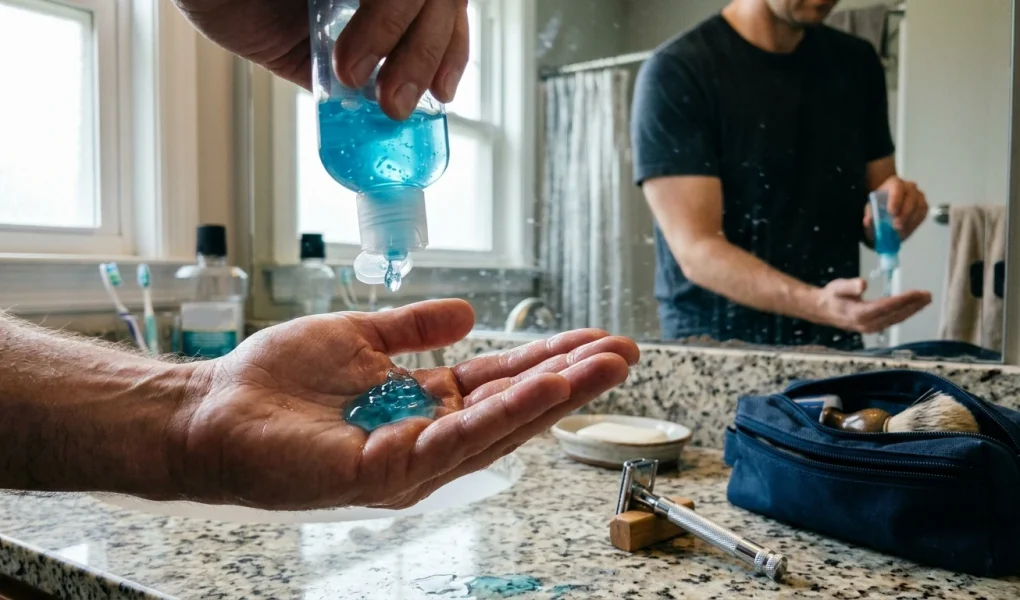
- Dispense an almond-sized dollop (approx. 5–7 ml) of clear shaving gel into your palm.
- Rub your hands together to activate the water-binding polymers.
- Massage the gel firmly against the grain of your facial hair across your neck, jawline, and cheeks. Massaging upwards lifts recumbent (flat-lying) hairs off the skin surface and coats the base of each shaft.
- Allow the gel to dwell on your skin for 60 to 90 seconds before taking your first pass. This dwelling window allows humectants to penetrate the hair cuticle.
Phase 3: The Shaving Pass
- Electric Shaver: Glide the shaver with gentle circular motions (rotary) or short linear strokes (foil). Let the high-speed motor do the cutting; never push the head aggressively into your flesh.
- Manual Razor: Shave with the grain first at a 30-degree blade angle, utilizing light, controlled strokes. Because clear gel provides total visibility, you can easily navigate around moles, blemishes, and sharp jawbone contours.
- Rinse the cutting head under running warm tap water after every 2 to 3 strokes to maintain unobstructed blade exposure.
Phase 4: Post-Shave Rinsing & Barrier Restoration
- Rinse all remaining gel residue with cool or lukewarm water. Cool water helps constrict peripheral capillaries and reduce surface redness.
- Pat your skin dry with a clean, freshly laundered towel—never scrub or rub vigorously.
- Follow immediately with an alcohol-free hydrating aftershave balm containing ceramides or squalane to reseal the stratum corneum.
Frequently Asked Questions
Is shaving gel better than shaving cream for sensitive skin?
Yes. Shaving gels typically provide a higher concentration of lubricating polymers and humectants without the heavy alkaline soaps or aerosol propellants common in standard creams. This creates a slicker boundary layer that prevents blade tugging and significantly reduces razor burn on reactive skin.
Will clear shaving gel dull my electric shaver blades faster?
No, quite the opposite. Using a water-soluble clear shaving gel lubricates the interface between the moving cutter teeth and the stationary foil/comb, reducing steel-on-steel friction and thermal wear. As long as you rinse the head thoroughly under warm water after each session, blades stay sharper longer.
Can I use hair conditioner or body wash as a substitute for shaving gel?
While conditioners provide slickness in an emergency, they contain heavy silicones, quaternary ammonium salts, and conditioning waxes that are not formulated for facial absorption. These compounds can clog razor blade mechanisms and lead to comedogenic breakouts (clogged pores) on sensitive facial skin.
Get our latest guides, news, and insights highlighted in your Google Search & AI Overviews.


 THE 60-DAY HAIR CHALLENGE